Hey folks, if you’ve ever wandered through a craft shop, seen that cool frosted glass mug or decorative window pane, and thought “how’d they get that smooth, even etch?”, you’re not alone. For years, I’ve gotten this exact question from shop owners, DIY glass artists, and even small manufacturing folks hitting a wall with their current etch setup: “Can a rotary barrel machine even do glass etching?” As a rotary barrel machine supplier, I get asked this nonstop—and the short answer? Yeah, it works, but only if you’re doing it right (and that’s where most folks mess up). Rotary Barrel Machine
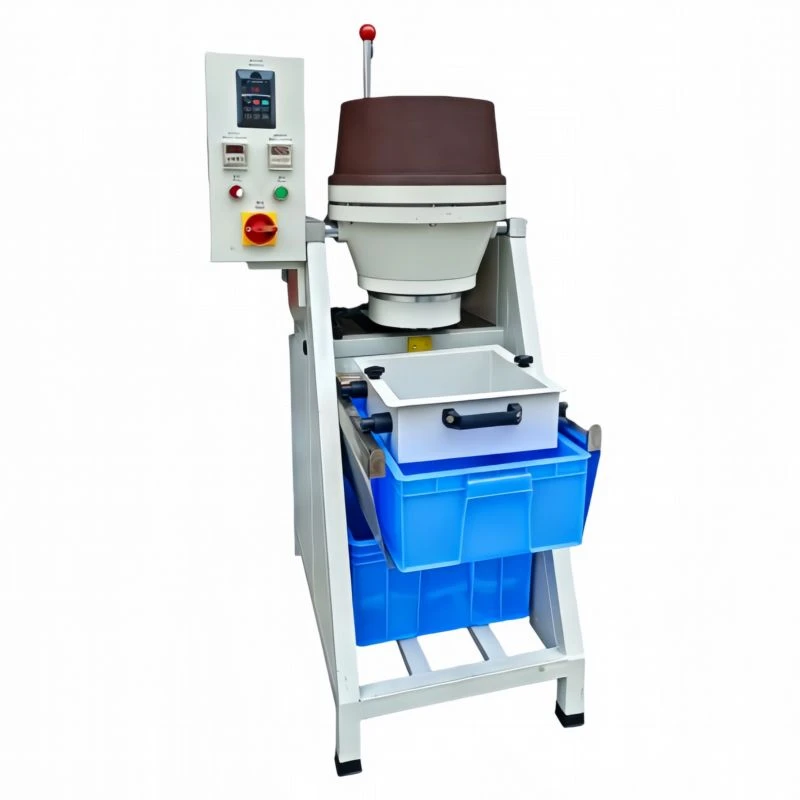
First, let’s cut the jargon. A rotary barrel machine is basically a horizontal, rotating drum (think a big, heavy-duty plastic or steel barrel) that spins parts around inside, mixed with a media (the abrasive or chemical stuff that does the work), some water, and a little additive depending on the job. Most people associate these with polishing metal, deburring plastic parts, or even cleaning castings—so glass feels like a weird fit at first. But here’s the thing: glass is super smooth, but it’s also brittle, and etching it just means creating tiny, uniform surface scratches that scatter light to get that frosted look. That’s exactly what a rotary barrel can deliver… if you skip the mistakes everyone makes when they first try it.
Let’s talk about why it’s not as obvious as you think. A lot of folks grab a barrel, throw in glass pieces, grab their go-to metal deburring media, and hit go—only to end up with chipped edges, uneven etches, or even glass that cracked mid-spin. Why? Glass is denser than most plastics, way softer than steel, and way more fragile than metal parts you’d run in a barrel. The first rule of thumb here: no hard metal media. That’s a non-starter. If you use steel shot or grit, it’ll scratch the glass too deep or crack it. Instead, you need media that’s both abrasive enough to etch and soft enough not to damage the glass. The go-to here is glass bead media (shaped like tiny spheres, so no sharp edges to nick the glass) or porcelain media. I’ve seen customers swap from steel to glass beads and go from a 30% glass breakage rate to 2%—game changer.
Wait, but what about chemical etching vs mechanical etching in a barrel? Some people ask, “can I put hydrofluoric acid in the barrel?” Nah, that’s a huge no. Hydrofluoric acid is super toxic, fumes are dangerous, and in a rotary barrel, it’d seep through the drum walls if it’s not sealed right, plus it’s way harder to control the etch that way. The good news is, rotary barrel machines work for mechanical etching—no harsh chemicals needed, which is a big win for small shops that don’t want to deal with OSHA hoops for toxic materials. The mechanical etch from the rolling media creates that frosted finish naturally, evenly across all the pieces inside the barrel, because they’re all tumbling and getting abraded the same amount.
Here’s where it gets actually useful for small-scale and medium-scale operations. If you’re etching a batch of 50 wine glasses, 100 decorative glass coasters, or even small glass vials for candle companies, a rotary barrel machine is way faster than hand etching. Hand etching takes hours per piece, you have to mask every part you don’t want etched, and even then it’s inconsistent. With a barrel, you can load all the glass pieces together, load the media and a mild, glass-safe etch additive (something like a 10% solution of hydrochloric acid, way weaker than the industrial stuff, that speeds up the surface abrasion without harming the glass), set the barrel to spin at 20-30 RPM (too fast and the pieces bounce, too slow and they don’t tumble enough), and walk away. In 1-2 hours, you’ve got a whole batch of uniform etched glass—no masks, no hand scrubbing, way less labor.
But let’s be real, it’s not for every glass job. If you’re doing custom one-off pieces, a rotary barrel is overkill. If you’re etching thin glass, like phone screen protectors, it’s probably not great—too much tumbling will scratch the surface too much. But for medium-batch, uniform glass etches? It’s perfect. I had a customer last year who makes custom glass water bottles for a local gym chain. They were hand etching each bottle, taking 15 minutes per, and had a 20% breakage rate from hand tools. They switched to a 5-gallon rotary barrel machine, used glass bead media, and got their etch time down to 90 seconds per bottle, breakage rate to 3%, and saved $12k a year in labor. That’s not a small win.
Now, let’s address the big myths I hear all the time. Myth #1: Rotary barrels can’t etch unevenly. No, that’s only if you load the barrel wrong. If you overfill it (more than 70% of the barrel’s capacity), the pieces can’t tumble freely, so some parts don’t get any media contact. Fill it 50-60% full, add enough water to cover the media and glass (about 1 part water to 2 parts total media/glass), and you’re golden. Myth #2: It’ll ruin the glass. Only if you use the wrong media or wrong RPM. I’ve had people come to me with chipped glass because they used 100-grit sandpaper as media—too coarse. Stick to 220-400 grit glass beads, that’s the sweet spot for a smooth, even etch without deep scratches.
Another pro tip for folks running these machines: add a tiny bit of dish soap to the water mix. It cuts down on static, so glass pieces don’t stick together, and keeps the media from clumping. I learned that from a customer who was getting pieces stuck together and ending up with half-etched glass, and once they added a drop of Dawn (generic works too) per gallon of water, that problem was gone.
Wait, but what about large glass pieces? Like window panes or decorative glass art over 1 foot wide? A standard rotary barrel is too small for that, but you can get a custom-sized barrel—we build custom barrels up to 50 gallons, big enough for large flat glass pieces, as long as you stand them on edge so they tumble without breaking. We had a art glass studio that used our 30-gallon custom barrel to etch 18×24 inch decorative panels for a hotel lobby, and they said the finish was way more consistent than their old sandblasting setup.
Now, as someone who sells these machines, I’m not here to hype it up as the solution for every glass etching job. I’m here to tell it like it is: if you’re dealing with batches of glass, need consistent results, want to cut down on labor and breakage, a rotary barrel machine is absolutely worth looking into. But you have to do your part with the media, load size, and settings. Most people don’t know that, so they try it once and write it off as “too harsh” when it’s just a setup issue.
Let me throw out a quick case study that’s not from a big company—my neighbor runs a small craft shop, makes glass ornaments for Christmas. She was etching each ornament with a sandblaster, which was messy, required a mask for her to wear all day, and she only could do 10 ornaments an hour. She bought a 10-gallon rotary barrel machine from us, tried it with glass beads, and now does 50 ornaments an hour, no mask, no mess, and her breakage rate dropped by half. She texted me last week saying her annual sales were up 25% because she could make more product in less time. That’s the kind of win I love to see.
So, if you’re someone who’s been struggling with your current glass etching process—whether it’s hand etching that’s inconsistent, sandblasting that’s too messy, or high breakage rates—hit me up to chat more. I can walk you through what size barrel you need, what media works best for your specific glass pieces, and tweak settings to get the finish you want without wasting glass. No hard sells, just straight talk about what works and what doesn’t, because I’ve been in this game long enough to know that the best solutions are the ones that fit your needs, not the ones that sound fancy.
Wait, before I wrap this up, let’s make sure I didn’t miss any of the key points people always ask. Can you do frosted tumblers? Yep. Can you etch glass signs? Absolutely. Can you use it for both thin and thick glass? Just adjust the media size—thicker glass can handle slightly coarser beads, thinner glass needs finer 400-grit beads. The short answer is, rotary barrel machines aren’t just for metal or plastic—they’re a viable, cost-effective option for glass etching when you’re working in batches, and you do the setup right.
Now, if you’re ready to stop guessing and figure out if this works for your shop, just reach out to talk through your needs. I’m here to help you sort through the details, no fluff, no weird fine print.
Vibratory Finishing Machine References:
- Glass Processing Technology: Principles and Practice, 3rd Edition, 2019, Elsevier
- Rotary Finishing for Industrial Applications, 2021, Society of Manufacturing Engineers
- Glass Etching for Small-Scale Manufacturers, Craft + Hobby Press, 2022
- OSHA Guidelines for Abrasive Blasting and Tumbling Operations, 2020, Occupational Safety and Health Administration
KS Lab Finishing Co., Ltd.
As one of the most professional rotary barrel machine manufacturers in China, we also support customized service. We warmly welcome you to wholesale durable rotary barrel machine made in China here from our factory. If you have any enquiry about pricelist, please feel free to email us.
Address: No.11-14, Yantian Shuibei Commercial Street, Fenggang Town,Dongguan,China
E-mail: sales@kslabfinishing.com
WebSite: https://www.kslabfinishing.net/
